
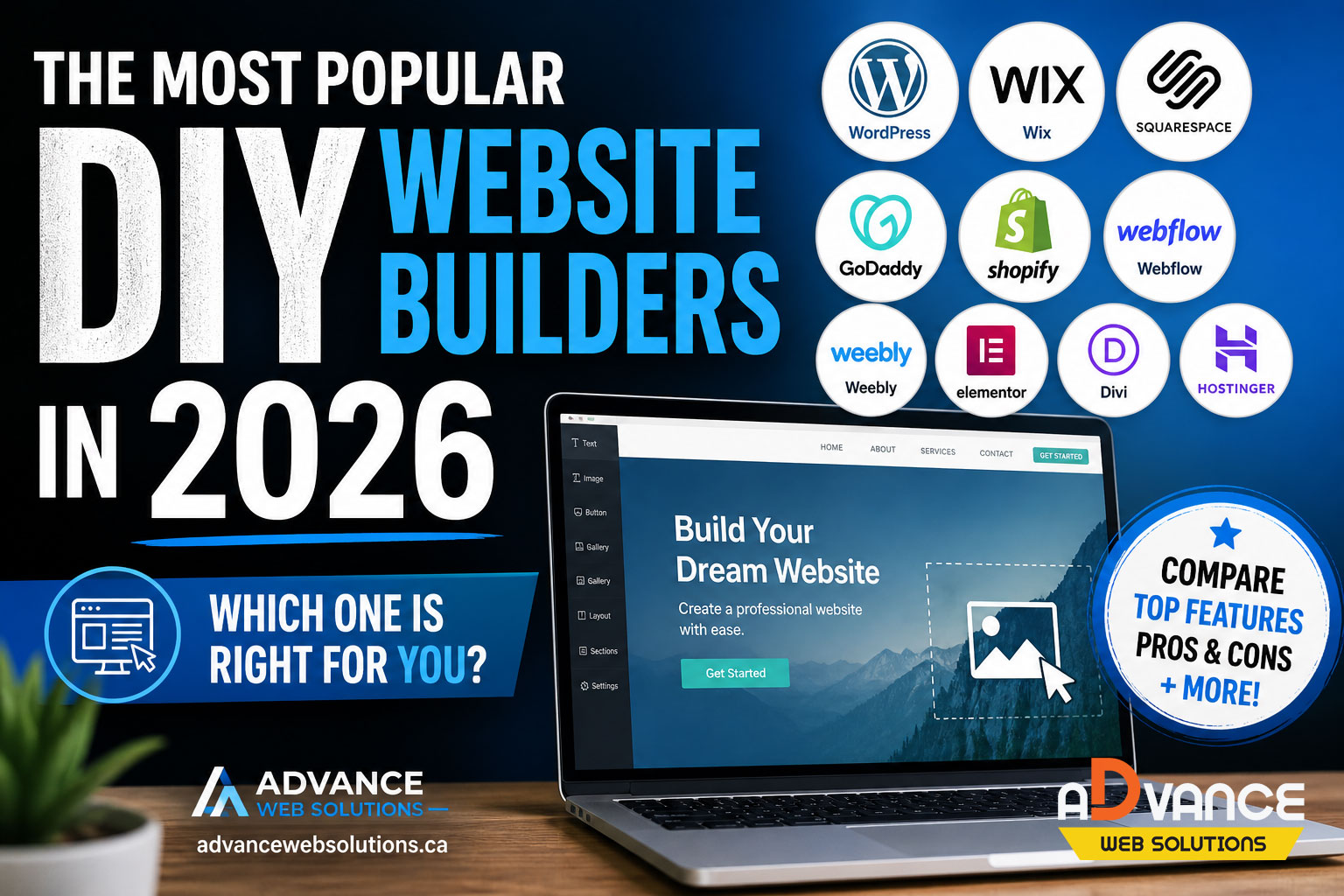
One of the interesting parts of working as a web designer is how often we meet clients who first tried building their website themselves.
Doing it yourself is always tempting—mainly because of cost savings, full control, and the ability to flex your creativity. Many businesses start this way, with plans to bring in professional help later once they’ve hit the platform’s limits.
But if you’re new to web design, what are your actual options?
It’s completely normal to feel a bit like a deer in the headlights. There are a lot of platforms out there, and they all promise to be “easy.” So let’s break it down.
Below are the most popular DIY website builders in 2026, based on market share, usability, and overall popularity—plus some insight into which might be right for you.
1. WordPress
WordPress has been around for what feels like forever, and it’s still the undisputed leader. Roughly 43% of all websites on the internet run on WordPress, which is a staggering number.
That said, it’s important to understand that WordPress is self-hosted. Unlike most DIY builders, you’ll need separate hosting and a domain, which adds a layer of complexity for beginners.
Most users start with a pre-made theme and customize it with their own content. However, two major builders—Elementor and Divi—have evolved within the WordPress ecosystem and are worth mentioning separately below.
2. Wix
Wix has emerged as the industry leader for true “all-in-one” DIY website building.
It handles hosting, domain connection, and design all in one place, making it incredibly appealing for beginners. Its drag-and-drop interface is intuitive and continues to improve, even attracting some professional designers.
Wix is especially popular with small businesses and is estimated to hold around 45% of the DIY website builder market. If you’re going it alone, this is often the first place to start.
3. Squarespace
Squarespace has been a strong player for years and offers many of the same benefits as Wix.
Currently, it holds roughly 16–18% of the DIY market. It’s often considered slightly easier to use than Wix once you get the hang of it, but that simplicity can come at the cost of flexibility.
This highlights a common tradeoff with DIY builders:
The easier a platform is to use, the more limited it tends to be in customization.
4. GoDaddy Website Builder
GoDaddy isn’t always a favorite among professional web designers, but it remains a popular choice—largely because it’s the world’s largest domain registrar.
Since you can build a website directly after purchasing a domain, it becomes a convenient first step for many users.
However, GoDaddy’s templates can feel restrictive, and customization options are limited compared to competitors. It’s a budget-friendly entry point, but many users eventually outgrow it.
5. Shopify
Shopify is a major name in web design—but with a specific focus.
It’s built primarily for e-commerce websites, meaning it’s ideal if you’re selling products online. It’s user-friendly and relatively easy to learn, but design flexibility can be somewhat limited.
If you’re not building an online store, Shopify likely isn’t the right fit. But for e-commerce, it’s one of the best DIY options available.
6. Webflow
Webflow is a newer platform that’s gaining serious traction, especially among designers and agencies.
With a smaller market share (around 1%), it’s still growing—but quickly.
Unlike template-heavy builders, Webflow allows for fully custom design, making it far more powerful—but also more complex. It sits somewhere between DIY builders and professional development tools.
If you’re willing to invest the time to learn it, Webflow can produce high-end results.
7. Weebly
Weebly was once a major player—similar to Wix or Squarespace—but has since declined in popularity.
It still maintains a large user base from earlier years, but it hasn’t kept pace with modern features and design capabilities.
Today, it’s often considered more of a legacy platform, though it still ranks among the top options due to its existing install base.
8. Elementor (WordPress Builder)
Elementor is one of the two major builders within WordPress and is widely used by professionals.
It transforms WordPress into a more visual, drag-and-drop experience while still offering deep customization.
That said, because it’s still built on WordPress, some changes require backend adjustments. It’s powerful and scalable—but comes with a learning curve.
9. Divi (WordPress Builder)
Divi is Elementor’s main competitor and has built a strong following among agencies and freelancers.
It offers extensive customization options and a large library of templates. While it can be slightly less intuitive than Elementor, it excels in long-term flexibility and maintainability.
Divi can absolutely be used as a DIY tool—especially if you start with pre-made layouts—but it’s best suited for users willing to invest time into learning the platform.
10. Hostinger Website Builder
Hostinger’s website builder is a newer and lesser-known option, but it’s carving out a niche—especially with its AI-powered features.
It includes tools like AI website generation and logo creation, making it an appealing option for beginners looking for speed and simplicity.
While it may not yet match the major players in flexibility, its focus on AI could make it more relevant in the years ahead.
Should You Build Your Website Yourself?
If you’ve decided to try building your own website, the good news is—you have plenty of options.
There are countless online resources to help you learn, and many platforms are designed specifically for beginners. The key is choosing the one that best fits your goals, budget, and willingness to learn.
That said, DIY builders do have limitations.
When It Makes Sense to Hire a Professional
At Advance Web Solutions, we often help clients who started with a DIY platform and are ready to take things to the next level.
We can assist with:
- Updating and improving pre-made themes
- Ongoing maintenance and support
- Design and functionality upgrades
And when you’re ready, we can build you a fully custom website that goes beyond the limitations of templates.
A professionally designed website doesn’t just look better—it performs better, ranks better, and converts more visitors into customers.
Sometimes, getting it done right the first time can save you time, money, and frustration down the road.