
Web design is no longer a new industry, and people have been using websites for their businesses for decades. Despite this, there is still one thing many business owners don’t know much about, and sometimes they can be a little reluctant or embarrassed to admit it.
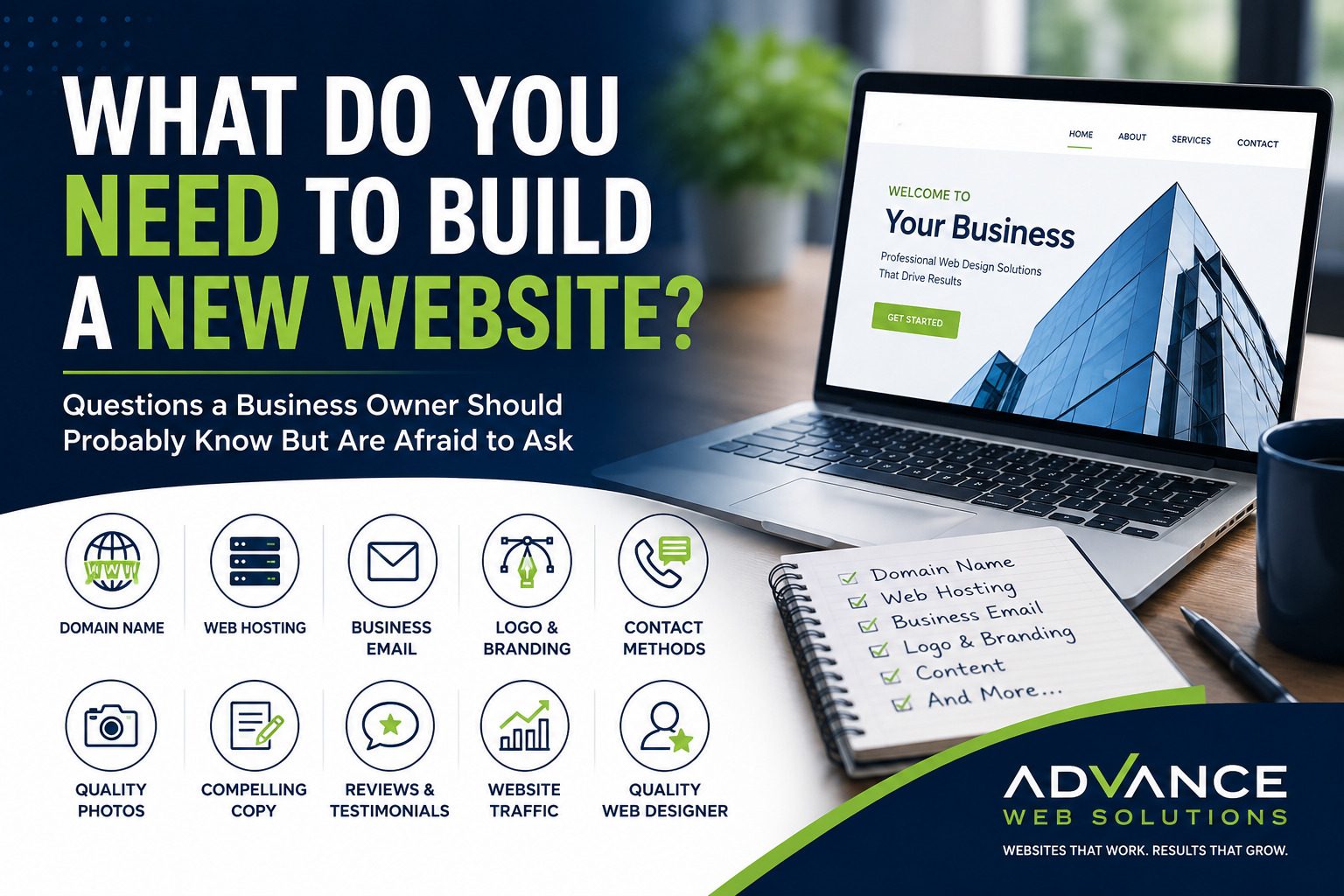
After all, if you’re a business owner, you’re supposed to know business things—even if some of them fall outside your comfort zone or personal interests. For that reason, we decided to answer one of the questions we hear most often when people ask us about websites: What do you actually need to build a website?
I’m glad you asked, and we’ll try to provide the best, most non-technical answer possible.
1. A Domain Name
Every website starts with a domain name, which is a choice you get to make, provided it hasn’t already been registered by someone else. Our website domain name is advancewebsolutions.ca, which is essentially your digital address where people can find you online.
Think of a domain name like the address of your house where someone would send your mail. A domain name isn’t technically something you own forever; it is registered or renewed for a set period of time, usually one or more years. This is why domain names need to be renewed to remain active.
2. A Web Hosting Plan
Some people still struggle to grasp the concept of website hosting, which is completely understandable. Simply put, web hosting is the file space you rent online to store your website files, similar to an online hard drive.
Depending on your hosting plan, you have a set amount of storage space and bandwidth available each month. If your domain name is your home address, then your web hosting is the lot you build your house on.
Your domain name needs to connect to your web hosting account for your website to function properly.
3. Business Email Accounts
Another popular question is how to set up business email accounts using your domain name instead of Gmail, Hotmail, Yahoo, etc.
Typically, email accounts can be set up through your web hosting plan using some of the same storage resources as your website. Email can also be handled through dedicated providers such as Google Workspace or Microsoft Outlook.
Your web design company may be able to set these accounts up for you, although they may sometimes enlist the help of an IT company for more complicated email configurations.
4. A Business Logo
Technically speaking, you don’t need a business logo to build a website, but most websites are designed around a company’s existing branding. Your logo is one of your main identifiers and helps establish the colours, style, and overall look of your website.
For this reason, it’s probably wise to start with a good logo. A well-built website paired with a poor logo can stand out like a sore thumb.
There’s a good chance your web design company can design a logo for you as well, but you may also choose to work separately with a graphic designer or use freelance websites such as Fiverr.
5. Multiple Methods of Contact
The whole idea of having a website is to give people a way to get in touch with you if they’re interested in your products or services. Therefore, it goes without saying that you’ll need at least a phone number and an email address.
That being said, there are plenty of other methods of contact as well, including online submission forms, appointment booking systems, live chat, social media messaging, and more.
While not technically mandatory, having convenient ways for potential customers to contact you is an important part of having a professional, effective website.
6. Quality Photos
Photos for websites generally come from two main sources: photos you take yourself or have taken by a professional photographer, and stock photo websites.
Stock photos are images taken by professional or hobbyist photographers specifically for use on websites and other creative projects. Some stock photos are free, while others require a paid license.
Most professional businesses eventually invest in professional photography because authentic, high-quality images can help people feel more comfortable with and trusting of your business.
7. Compelling Copy
Sometimes considered the most boring part of building a website, website copy is actually one of the most important.
You need text for each page of your website, and the quality of that writing matters tremendously. Some people are good writers and will choose to create the content themselves. Others may hire a professional copywriter, or use a web design company that provides copywriting as part of its services.
Either way, this part of the process deserves proper attention if you want your website to produce real results.
8. Reviews and Testimonials
You may consider this something you can build over time, but it’s better to start right from the beginning while your website is being built.
One of the first things you should establish is a Google Business Profile, which can help your business appear in local search results and display important information such as your website, hours, location, and contact information.
More importantly, it allows you to collect Google reviews from real customers, which can help build trust with potential customers and contribute to your local SEO efforts.
Reviews aren’t limited to Google, either. Depending on your industry, customers may also be looking for reviews on Facebook, Yelp, or other platforms.
9. Website Traffic
Once your website is online, there’s a common myth that the rest takes care of itself—you kick up your feet and watch the business come in.
Unfortunately, that’s not how it works.
This is one of the biggest misconceptions about websites and one of the areas where the idea of simply building a website yourself through a popular DIY website builder can fall short.
Once you have a quality website, you need to send potential customers to it. This can happen through SEO rankings, social media, paid digital advertising, print advertising, networking, word of mouth, and many other methods.
If you don’t have traffic, you’re missing half of what is needed for a successful website.
10. A Quality Web Designer
Of course, this begs the question: once you know everything that’s needed, do you want to attempt it yourself, or do you want to have a professional handle it from the beginning?
Hiring a quality web designer isn’t technically mandatory, but it can make a huge difference when building a professional website.
Doing everything yourself can mean extra time you don’t have, extra work, and a lot of learning as you go—at a time when your schedule is probably already full.
Having a professional handle the process can save you time, avoid costly mistakes, and give you a better end result.
Whether you decide to go it alone or make the wise decision to hire a web design professional, this is the information you should understand before getting started.
The better your understanding of how everything works, the more knowledgeable and productive your conversations will be with any web designer or developer.
Proper planning and knowledge are key. And if you’re not a “learn as you go” person, that’s where Advance Web Solutions can step in.
If you want someone to guide you every step of the way toward building a professional, top-performing website, reach out to us today with any questions you may have.
We’re happy to assist in any way possible and introduce you to what the Advance Advantage is all about.