
When you think of history, the internet is probably not the first thing that comes to mind. You’re more likely to think about major wars, groundbreaking inventions, world religions, or how cultures have evolved over time.
The internet, however, feels modern—not historical—which makes it easy to overlook its place in history. Despite being relatively new, it has evolved at an incredible pace. In fact, it’s fascinating to see how quickly things have changed and what has already become outdated by 2026.
Here are 21 interesting and amusing facts about the internet from a web design expert’s perspective that many people don’t know about its origins and early days.
1. It was originally created for the military
The internet wasn’t built for entertainment, social media, or even general education. It was originally developed as ARPANET, a project funded by the U.S. Department of Defense. Its goal was to create a communication system that could remain functional even if parts of it were destroyed—making it highly resilient and strategically valuable during times of conflict.
2. Netscape Navigator was once the standard
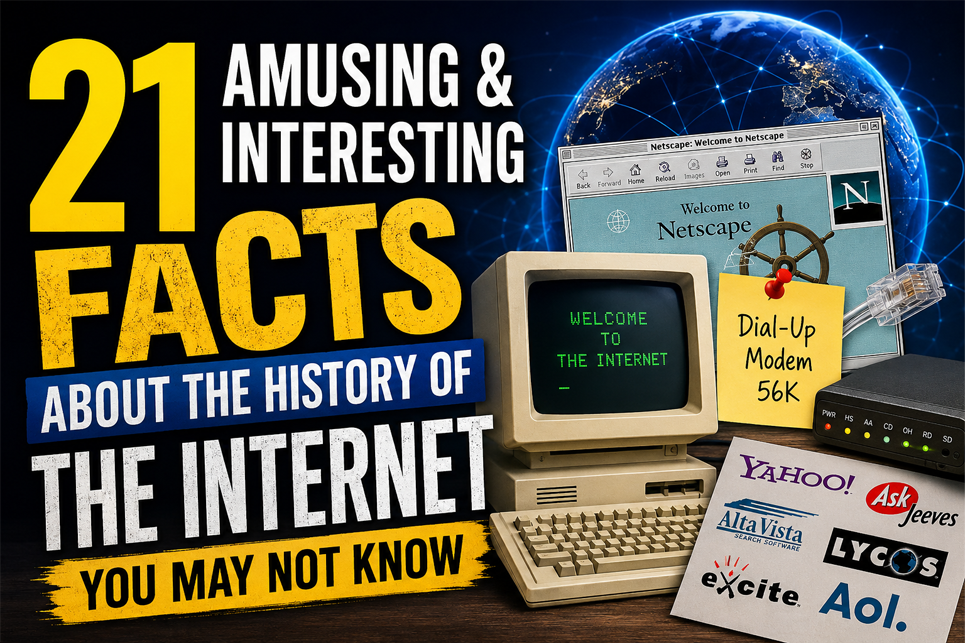
Before modern browsers took over, Netscape Navigator was the dominant way people accessed the internet. In the mid-1990s, it held the majority of the browser market. Looking back, it’s similar to how VHS tapes were once standard before being replaced by DVDs and streaming services.
3. Dial-up internet blocked your phone line
Early internet users had to connect using dial-up modems, which used telephone lines to access the web. This meant you couldn’t use your phone and the internet at the same time. On top of that, connection speeds were extremely slow, and even loading a single webpage could take several minutes.
4. The World Wide Web is less than 35 years old
The World Wide Web, which allows us to browse websites, was introduced in 1991. That means it’s only been around for a few decades. For younger generations, it’s hard to imagine a world without it, but for many others, it represents one of the biggest technological shifts in modern history.
5. Social media came much later
While many people associate the internet with social media, platforms like Facebook, Instagram, and TikTok didn’t appear until much later. Early internet users primarily used email, forums, and basic websites. Social media gradually evolved from these simple communication tools.
6. Google wasn’t the first search engine
Google may dominate today, but it wasn’t the first search engine. Early tools like Archie, WebCrawler, Lycos, Yahoo, and AltaVista helped users navigate the web before Google existed. Google’s success came from improving search accuracy and user experience.
7. MySpace was the original Facebook
Before Facebook became a global giant, MySpace was the leading social network. It allowed users to customize their profiles, share music, and connect with friends. While it may seem outdated now, it played a major role in shaping modern social media platforms.
8. Email was once considered a fad
At one point, some people believed email wouldn’t replace traditional communication methods like mail or fax. Today, it’s one of the most important tools for both personal and professional communication, proving early skepticism wrong.
9. The first spam email was sent in 1978
The first known spam email was sent by Gary Thuerk to hundreds of ARPANET users. While it successfully promoted a product, it also annoyed many recipients and set the stage for spam becoming a long-term issue on the internet.
10. The first online games were text-based
Before graphics and advanced gameplay, early online games relied entirely on text. Players would read descriptions and type commands to interact with the game. While simple by today’s standards, these games laid the foundation for modern online gaming.
11. The World Wide Web was invented by Tim Berners-Lee
Tim Berners-Lee developed the World Wide Web in 1989 while working at CERN. His invention allowed users to link and share documents across networks using hypertext, which remains a core part of how the web works today.
12. Early websites were filled with pop-ups and banner ads
Online advertising in the early days was often intrusive, with pop-ups and flashing banner ads everywhere. Many websites were cluttered and overwhelming, making the browsing experience frustrating compared to today’s cleaner designs.
13. The first webcam watched a coffee pot
One of the first webcams was set up at Cambridge University to monitor a coffee pot. This allowed researchers to check if coffee was available without leaving their desks—a surprisingly practical use at the time.
14. The internet once ran on a very small network
In its early stages, the internet connected only a handful of computers. This small-scale network eventually expanded into the massive global system we rely on today, supporting billions of users worldwide.
15. The first photo online was of a pop band
The first image uploaded to the web was of a parody band called Les Horribles Cernettes. It was used as a test to see whether images could be displayed online—something we now take completely for granted.
16. Garfield had an early email service
In the late 1990s, a Garfield-themed website offered free email accounts. While it wasn’t a major milestone in internet history, it highlights how creative and experimental early online services could be.
17. It wasn’t always global
The internet started in the United States and gradually spread to other countries. Early access was limited, and global connectivity took years to develop into what we now consider standard.
18. Pirated music helped shape the internet
File-sharing platforms like Napster changed how people accessed music. While controversial and often illegal, they forced the music industry to adapt—eventually leading to streaming services like Spotify.
19. The first YouTube video was very simple
The first YouTube video, “Me at the Zoo,” was uploaded in 2005. It’s only 18 seconds long, yet it marked the beginning of one of the largest content platforms in the world.
20. Most of the internet is hidden
Only a small portion of the internet is indexed by search engines. The majority exists in the “deep web,” which includes private databases, academic resources, and secure systems not accessible through standard searches.
21. The internet evolved faster than almost any invention
From a military experiment to a global necessity, the internet has grown at an unprecedented rate. In just a few decades, it has transformed communication, business, entertainment, and everyday life.
Final Thoughts
The internet may feel like it’s always been around, but its history is surprisingly short—and full of unexpected twists. From dial-up connections to global connectivity, it’s evolved faster than almost any invention in human history.
If you enjoyed this article, feel free to share it with others who might find it interesting.
If you’re a business owner or entrepreneur, we specialize in web design, graphic design, and digital marketing. Don’t hesitate to reach out if you have questions or need help growing your online presence—we’re here to help your business succeed online.